AESIA Guidelines on the AI Act – Guide No. 10: Robustness

The Spanish Agency for the Supervision of Artificial Intelligence (AESIA) has published a set of guidelines developed under the Spanish AI regulatory sandbox. Guide No. 10 is dedicated to robustness, the second of the three technical requirements set out in Article 15 of the AI Act, after accuracy, which we examined in Guide No. 9.
The Guide is non-binding. It was revised on 17 July 2026 to reflect the amendments introduced by the Digital Omnibus, which we discussed in The Digital Omnibus on AI: What Regulation (EU) 2026/1744 Actually Changes. It is addressed mainly to providers, but it also gives deployers specific organisational and technical responsibilities within their sphere of control. Among the technical standards under development, it highlights prEN 18229-2, “AI Trustworthiness Framework – Part 2: Accuracy and Robustness”, which is expected to become the harmonised basis for assessing both properties.
Failing safely
The starting point is recital 75 of the AI Act. High-risk AI systems must be resilient against harmful or undesirable behaviour caused by their own limitations or by the environment in which they operate, such as errors, faults, inconsistencies or unexpected situations.
AESIA draws a clear practical consequence. A high-risk system must be able to detect when it is operating outside the input domain defined by its intended purpose. Where robustness cannot be guaranteed, it must be ready to stop in a controlled way. Robustness is therefore not only about performing well under normal conditions, but also about failing safely.
What Article 15 requires
The Guide focuses on two paragraphs of Article 15:
- Paragraph 1 requires an appropriate and consistent level of robustness throughout the lifecycle of the system.
- Paragraph 4 requires high-risk systems to be as resilient as possible to errors, faults or inconsistencies. It allows robustness to be achieved through technical redundancy, such as backup or fail-safe plans, and sets specific obligations for systems that continue to learn after being placed on the market or put into service.
The Guide organises its measures around four areas: robustness assessment, resilience to errors, redundancy and backup plans, and systems that continue to learn.
What robustness means
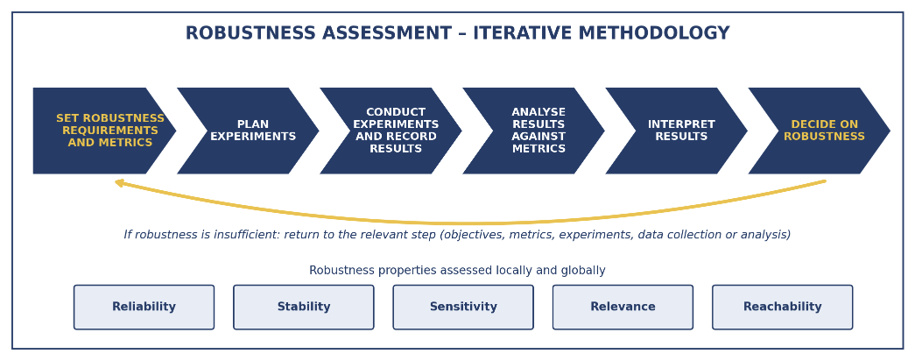
AESIA describes robustness through five properties:
- Reliability: consistency between values estimated at different times. Following ISO/IEC 25059, it is treated as an aspect of software quality.
- Stability: how far the output may change, in a controlled way, when inputs vary within a given domain.
- Sensitivity: how much the output may vary when inputs change. This matters where precision against a known reference is essential, as with an AI-controlled insulin pump whose doses must stay within the limits recommended by the manufacturer.
- Relevance: the impact of each input on the output, which helps confirm that the system’s accuracy rests on the right factors.
- Reachability: accuracy over several steps in agent-based systems that operate in a perception-action loop.
These properties can be checked locally or globally:
- Local robustness is checked around specific examples. An image correctly classified as a car should still be classified as a car when rotated by five degrees.
- Global robustness gives guarantees for all possible inputs within a defined range. It is harder to specify.
AESIA recommends checking both. Local analysis reveals weak points and boundary cases that can be fixed during design; global analysis gives guarantees over the expected input domain. Both should take reasonably foreseeable misuse into account.
The Guide illustrates this with a system that detects false complaints. The provider takes a balanced set of true and false complaints, creates new versions in which 5% of the words are randomly replaced, and measures how sensitive the system is to these small changes.
An iterative method to assess robustness
The core of the Guide is a step-by-step method that the provider repeats until the system is robust enough:
- Set robustness objectives and metrics: how robust does the system need to be, and which properties matter?
- Plan experiments using statistical, formal or empirical methods, or a combination.
- Run the experiments, recording the results, the datasets used and all outputs.
- Analyse the results against the chosen metrics.
- Interpret them both over time and as a whole.
- Decide whether the system is sufficiently robust.
If it is not, the provider goes back to the step where the problem lies. It may add objectives or metrics, redesign the experiments, change how data are collected or correct the analysis.
The Guide also distinguishes verification from validation:
- Verification shows, with objective evidence, that the specified requirements are met. It does not require running the system on real data.
- Validation shows that the requirements for the intended purpose are met. It requires testing the verified system on real data.
According to AESIA, most types of data processed by neural networks can be analysed with at least one formal method under ISO/IEC 24029-2, although these methods have limits, especially in terms of scalability. In the false-complaint example, the provider combines statistical tests with a formal method based on word frequencies in a control group.
Robustness and hardware
Computing capacity strongly affects robustness, both when the system is in use and when it continues to learn. Robustness metrics should therefore be verified and validated on hardware that exactly replicates the final configuration: memory, CPU, numerical precision and processing speed.
Where the deployer installs the system, the installation instructions should state the hardware requirements and how they affect accuracy. For settings with limited resources, the Guide mentions techniques such as edge machine learning, distillation, continual learning and network compression or pruning. Hardware-related metrics, such as latency, throughput or performance per watt, should be documented before tests for the operational phase are designed.
Monitoring during operation
AI systems can change behaviour over time, so robustness must be monitored. This means observing statistics, data distributions and changes in how the system is used. Feedback mechanisms should help distinguish errors caused by the deployer’s misuse, errors in the system itself and errors due to the context. Troubleshooting should be recorded.
The deployer has a role too. It should be trained to:
- recognise when performance is declining;
- use the robustness dashboards provided by the provider;
- report possible malfunctions through the channels provided.
AESIA covers post-market monitoring in more detail in its Guide No. 13.
Resilience to errors, faults and inconsistencies
The provider must have strategies to anticipate failures and unintended consequences that could affect people’s safety or fundamental rights. These risks come from the risk management system under Article 9, which we examined in Guide No. 5: Risk Management.
The Guide recommends:
- alerts that notify the responsible people when robustness is compromised;
- automatic shutdown if nobody responds within a safe time, always allowing human intervention, as discussed in Guide No. 6: Human Oversight;
- fail-safe protocols;
- design review committees bringing together people from different fields to spot design inconsistencies early. In SMEs and start-ups, these can be company-wide working groups.
In the example of a system that supports decisions on employee promotions, some employees may have less information in the system than others. The Guide suggests alerts for incomplete profiles and an alternative ranking that estimates the missing information.
Redundancy and backup plans
Article 15(4) expressly allows robustness to be achieved through technical redundancy. The provider may offer:
- automatic backups of models, algorithms, logs and data;
- fail-safe mechanisms for components throughout the lifecycle;
- tools to recover data, models and the system after a failure;
- reproducibility, tracing and data-lineage tools that detect changes in the data affecting robustness or performance.
Redundancy and recovery plans should be both local and global, ideally with a second device or mechanism such as secure cloud hosting. In the false-complaint example, the system runs in data centres in different locations, scales automatically and goes through a pipeline of unit, integration and accuracy tests before each update is released.
Systems that continue to learn
For AESIA, systems that continue to learn include not only those that learn automatically during use, but also those updated through retraining. Providers and deployers must ensure that further training does not worsen robustness, accuracy or performance.
The Guide identifies three main types of degradation:
- model bias: a systematic error that indicates underfitting;
- model drift: the relationship between inputs and outputs changes;
- data drift: the distribution of input data changes.
To limit them, the Guide suggests techniques such as domain adaptation, transfer learning, out-of-distribution generalisation and continual learning, for example Elastic Weight Consolidation or experience replay. Where the correct answers are not available, providers can estimate performance and use alerts to detect silent failures. Catastrophic forgetting, when a model loses what it had learned before, should be tracked with specific metrics such as backward and forward transfer.
The quality of the data used for retraining is decisive. On this point, see Guide No. 7: Data and Data Governance.
The annexes
Two annexes complete the Guide:
- Annex I lists robustness metrics by type of task, from Cohen’s Kappa, the Matthews correlation coefficient and balanced accuracy to precision-recall curves, RMSE, maximum error and cross-validation. It also explains statistical, formal and empirical test methods, including input perturbation tests for images, sound and reinforcement learning.
- Annex II links robustness with uncertainty. It distinguishes aleatoric uncertainty, which cannot be reduced, from epistemic uncertainty, which can be reduced with more data, and proposes calibration and uncertainty-quantification techniques.
Documentation
The technical documentation should:
- explain how to obtain and interpret robustness metrics;
- state the possible ranges of configurable parameters and of input and output data;
- specify the latency and efficiency needed to achieve the declared robustness;
- set minimum acceptable values for the guaranteed metrics;
- describe how human supervisors are alerted, or the system is stopped, when those values cannot be guaranteed.
It should be updated after each relevant change, retraining or change in the operating context, and should explain known trade-offs, for example between robustness and privacy. AESIA’s Guide No. 15 sets out what the technical documentation should contain.
A practical sequence
For providers, the Guide translates into nine steps:
- Define the robustness properties relevant to the intended purpose and the identified risks.
- Set requirements, metrics and thresholds.
- Plan and run experiments using statistical, formal or empirical methods.
- Verify and validate the system on hardware that replicates the final configuration.
- Monitor robustness during operation.
- Put in place alerts, fail-safe protocols and controlled shutdown.
- Set up redundancy, backup and recovery plans.
- Control degradation in systems that continue to learn.
- Document metrics, results, thresholds and measures.
Robustness as the ability to fail safely
Guide No. 10 changes the question a provider should ask about its system. It is not only whether the system works under normal conditions, but how it behaves at the edges: with incomplete profiles, unexpected inputs, hardware limits, retraining or a change in context. AESIA’s answer is that a robust high-risk system must recognise when it is leaving its intended input domain, alert the people responsible, and stop in a controlled way when its declared metrics can no longer be guaranteed.
In practice, robustness is shown with evidence:
- tests that perturb inputs and probe boundary cases;
- verification and validation on the final hardware;
- backup and recovery plans;
- alerts for silent failures;
- documented minimum thresholds below which the system is suspended.
For deployers, the Guide adds a clear role: recognise when performance is declining, use the provider’s dashboards and report malfunctions. A system that cannot show how it will behave when things go wrong is not robust in the sense of the AI Act, however well it performs in the lab.
Sei pronto a trasformare i dati in valore per il tuo business?